
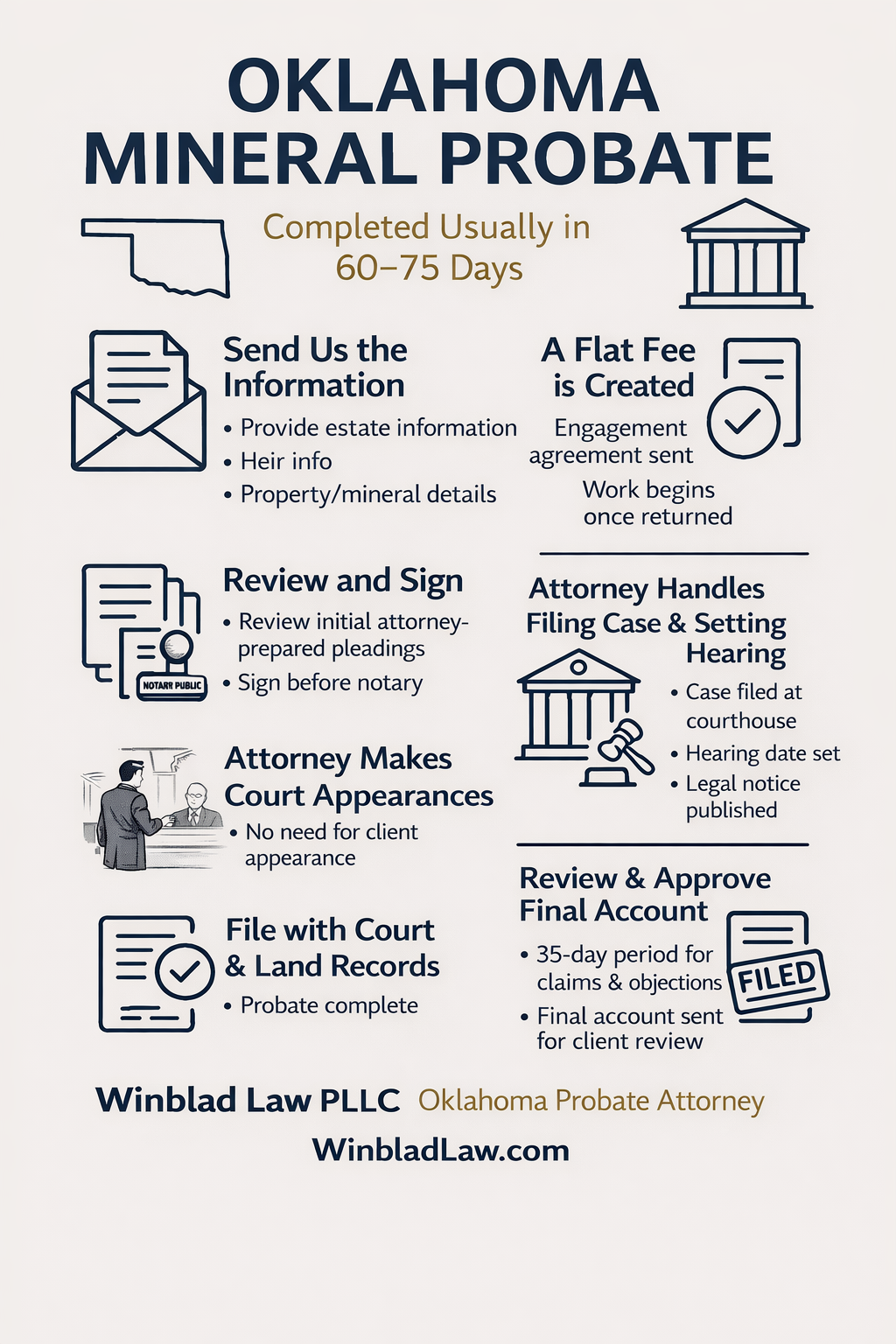
Fast-track your inheritance with Oklahoma Summary Probate in 60–75 days for a Flat Fee
Why is Probate Required for Oil and Gas?
When a loved one passes away owning oil and gas mineral interests in Oklahoma, a special probate process is usually required before heirs can receive royalty payments or transfer title. Mineral rights often cannot be claimed with a simple affidavit, and operators will not release funds without court-approved authority. This page explains how Oklahoma mineral probate works, why it is necessary, and how an experienced mineral probate attorney can help you navigate the filings, deadlines, and procedures to secure your family’s mineral interests.
Already have a probate completed or pending in another state? Click here for better information.
How to Probate Minerals In Oklahoma:
To probate mineral rights in Oklahoma, the court must appoint a personal representative and issue orders that transfer title from the deceased owner to the rightful heirs or beneficiaries. This requires filing a probate case in an Oklahoma district court, giving required notices, proving the will (if any), identifying the mineral interests, and obtaining a final decree that directs operators and county clerks to update ownership. Once the decree is filed in each county where minerals are located and provided to the oil and gas operators, suspended royalties can be released and ownership records corrected.
Transparent Flat-Fee Pricing
We believe in financial certainty for heirs and referring attorneys. For most uncontested Oklahoma probate matters involving a single decedent and mineral interests in one county, a flat fee of $3,600 is typically available.
What the Flat Fee Includes:
- Court Costs: All initial filing fees paid to the Oklahoma District Court.
- Publication Fees: The cost of mandatory legal notices in local newspapers.
- Attorney Time: All drafting, case management, and court appearances.
- Primary Recording: Filing the Final Decree in the land records of the primary county.
Qualifications for Flat-Fee Representation:
To ensure predictability, this rate applies to matters that meet the following criteria:
- Uncontested: There are no disputes between heirs or beneficiaries.
- Single Decedent: The matter involves the estate of one person (see “Joint Probates” below).
- Identifiable Interests: Legal descriptions are available from deeds, tax records, or royalty statements.
- Known Heirs: All immediate heirs can be identified and located for notice.
- Standard Administration: The estate does not involve complicated tax issues (such as federal estate tax filings) or active claims from creditors that require litigation or complex negotiation.
Multi-County & Multi-Generation Savings
- Additional Oklahoma Counties: If interests are located in more than one county, a supplemental fee of $75 per county is required to cover specific recording-related expenses.
- Joint Probates (Multiple Decedents): If title must pass through multiple generations (e.g., both parents), we can often administer these jointly. While this involves an additional charge, the total cost is significantly less than conducting separate probates for each individual.
Professional Note: Not all matters are suitable for flat-fee pricing (such as contested cases, lost heirs, or insolvent estates with heavy debt). We provide a definitive quote at the outset of the matter based on the information provided in your initial questionnaire.
For most uncontested Oklahoma Summary Probate matters—typically involving a single decedent and mineral interests in one county—we can often offer a flat fee of $3,600.
Multi-County Filings: If the decedent’s mineral interests are located in multiple Oklahoma counties, an additional fee of $75 per county is applied. This covers the specific recording-related expenses and administrative costs for each county courthouse involved.
The “Joint Summary” Advantage: Summary Probate is an excellent tool for clearing title through multiple generations. If we are probating both parents (or a parent and a child) simultaneously, we can often file Joint Summary Probates. While there is an additional charge for each additional decedent, the total cost is significantly lower than filing separate cases, saving the family thousands in filing fees and legal costs.
Formal Quotes: While most uncontested mineral titles are eligible for this flat-fee structure, some complex chains of title require a custom approach. We provide a definitive flat-fee quote at the outset of the matter once we have reviewed your specific information.

What exactly is a Mineral Probate?
A mineral probate is a court-supervised legal process used to transfer ownership of oil, gas, and other mineral interests after an individual’s death. In Oklahoma, probate establishes the death of the mineral owner, identifies the lawful heirs or beneficiaries, and authorizes the transfer of mineral interests and related royalty rights into their names.
An Oklahoma mineral probate lawyer can guide heirs through this process so mineral ownership is properly recorded and royalty payments can be released and paid to the correct parties.
What do I need to do to Get a Probate Started?
Getting a mineral probate started in Oklahoma typically begins with a brief telephone call or by completing an online interview. Click here for Interview. This allows us to review the situation, identify the mineral interests involved, and determine the appropriate probate procedure.
In most cases, there is no need for you to travel to our office or appear in court. Communication is usually handled by email, telephone, and mail. Clients are generally asked to review and sign only a limited number of documents necessary to move the probate forward.
Oklahoma Counties Served
| Adair | Alfalfa | Atoka | Beaver | Beckham |
| Blaine | Bryan | Caddo | Canadian | Carter |
| Cherokee | Choctaw | Cimarron | Cleveland | Coal |
| Comanche | Cotton | Craig | Creek | Custer |
| Delaware | Dewey | Ellis | Garfield | Garvin |
| Grady | Grant | Greer | Harmon | Harper |
| Haskell | Hughes | Jackson | Jefferson | Johnston |
| Kay | Kingfisher | Kiowa | Latimer | Le Flore |
| Lincoln | Logan | Love | Major | Marshall |
| Mayes | McClain | McCurtain | McIntosh | Murray |
| Muskogee | Noble | Nowata | Okfuskee | Oklahoma |
| Okmulgee | Osage | Ottawa | Pawnee | Payne |
| Pittsburg | Pontotoc | Pottawatomie | Pushmataha | Roger Mills |
| Rogers | Seminole | Sequoyah | Stephens | Texas |
| Tillman | Tulsa | Wagoner | Washington | Washita |
| Woods | Woodward |
Is Probate Difficult?
Probate is often straightforward when handled by an experienced Oklahoma probate attorney, particularly in cases involving mineral interests only. Most of the information needed comes from the client, including details about the deceased, the surviving heirs or beneficiaries, the property owned, and whether any known creditors exist.
Once this information is gathered, the attorney prepares the required court filings for the client’s review and signature and manages the procedural steps necessary to move the case forward.
Do I have to appear in Oklahoma probate court?
In most Oklahoma probate cases, personal court appearances are not required. Clients are often able to receive, review, and return documents by mail or electronic communication, while the attorney handles court filings and appearances on the client’s behalf.
An appearance may be required only in rare situations, such as when the probate becomes contested or additional testimony is requested by the court.
What if my Relative Didn’t Have a Will, Can I Still Probate the Minerals?
Yes. Mineral interests can be probated in Oklahoma whether or not the deceased had a will. If no will exists, the probate court applies Oklahoma intestacy statutes to determine the lawful heirs and how the mineral interests and related royalty rights are distributed.

How long does a mineral probate take?
The length of an Oklahoma mineral probate depends on the type of probate procedure that applies. In many cases, a summary probate procedure may be available, which significantly shortens the timeline.
A summary probate may be used if any of the following apply:
- The decedent did not reside in Oklahoma at the time of death;
- The decedent has been deceased for more than five years; or
- The total value of the Oklahoma estate subject to probate is $200,000 or less.
When a summary probate is available, the process is often completed in approximately 60 to 75 days, depending on court scheduling and local procedures.
If summary probate is not available, a standard probate may be required. A standard probate typically takes six months or longer to complete.[1]
Is there a Statute of Limitations to File Probate in Oklahoma?
Oklahoma does not have a Statute of Limitations to file a probate. However, doing so promptly can avoid monies being paid to a state’s unclaimed property fund.
Common Signs You Need Mineral Probate
You may need to open a mineral probate in Oklahoma if:
- Royalty payments have stopped
- Operators say title is unclear
- Funds are held in “suspense”
- Minerals were never properly transferred from earlier generations
- There was no previous probate in Oklahoma
These are extremely common issues, and probate often resolves them quickly.
I Filed an Affidavit of Heirship, why do I Need a Probate?
Can’t I just use an Affidavit of Heirship?
While an Affidavit of Heirship (AOH) is a lower-cost alternative, it is often a “temporary” fix that fails to provide the marketable title required to actually get paid. There are three primary reasons an AOH is often rejected:
- The 10-Year Rule: Under Oklahoma law (16 O.S. § 67), an Affidavit generally must be of record for 10 years before it is considered a valid transfer of title.
- The Existence of a Will: If the decedent left a Last Will and Testament, an Affidavit of Heirship is technically improper. A Will must be probated to be legally effective in Oklahoma.
- Surface Interests: If the property includes surface rights (land) in addition to minerals, an AOH is almost never sufficient to sell or mortgage the property.
“They accepted the AOH for the lease—why won’t they pay me?”
This is a frequent source of confusion. Oil companies have a lower “burden of proof” when they want to lease your minerals (to get the right to drill) than when they are ready to pay royalties.
An operator may accept an AOH to secure a lease just to get the well started, but their Division Order Analyst or a Title Attorney will almost always require a Final Decree from a Probate before they are legally cleared to release thousands of dollars in suspended funds. A probate provides the permanent legal finality that a simple affidavit cannot.
More on Affidavit of Heirship Here
What does Royalty Payments in Suspense or Payments on Hold Mean and How Can a Probate Help?
This means that the royalties or other payments have been calculated and set aside until the title of the person entitled to receive them has been established. Often this means an Oklahoma probate. A company may use a Division Order Analyst who determines what “title requirements” are needed to put royalties into “pay status”.
Do I Need to File Probate Case in Each Oklahoma County Where Minerals Are Located?
No. An Oklahoma probate case generally needs to be filed in only one county. Once the probate court enters an order distributing the estate, certified copies of that order—or a recorded notice of the order—may be filed in the other Oklahoma counties where mineral interests are located.
Recording the probate order in those counties has the same legal effect as if the personal representative or executor had executed and recorded mineral deeds conveying the interests to the heirs.
My or My Relative’s Funds are held by the Oklahoma Treasurer’s Unclaimed Property Division or listed in the Mineral Owners Escrow Account. How do I claim these?
Oklahoma State Treasurer’s Office/Unclaimed Property (405) 521-4275 or online www.ok.gov/treasurer/Unclaimed_Property/index.html.
They will inform you if a probate or an affidavit is sufficient to claim the funds. The Treasurer is very careful about disbursement of funds to claimants. Due to past fraudulent claims, the department requires several documents to be provided.
Glossary of Terms: Oklahoma Mineral Interests
- Affiant: The person who signs the Affidavit of Heirship, swearing that the facts contained in the document are true based on their personal knowledge.
- Affidavit of Heirship: A document used to claim a right to inherit mineral interests without probate but has drawbacks including a 10 year ripening period.
- Ancillary Probate: A legal proceeding required when a person dies owning property in a state (like Oklahoma) other than where they lived. Even if a probate was completed in another state, an ancillary probate is usually needed to move the Oklahoma title.
- Chain of Title: The historical “paper trail” of ownership for a piece of property. An Affidavit of Heirship is used to “link” a deceased owner to their living heirs in this chain.
- Cloud on Title: Any document, claim, or unreleased lien that casts doubt on the ownership of real estate. An unprobated estate is considered a “cloud” that may prevent a sale.
- Devisee: A person who receives real estate or mineral interests through a will. (Note: Until a will is probated in Oklahoma, a devisee’s rights are not legally enforceable).
- Division Order: A document sent by an oil company that confirms the decimal interest of an owner and authorizes the payment of royalties. Not required in Oklahoma.
- Marketable Title: A title that is free from reasonable doubt and is “clear” enough that a person can sell the interest to a buyer at fair market value. In Oklahoma, an Affidavit of Heirship does not achieve this status for 10 years.
- Pooling Order: An order from the Oklahoma Corporation Commission that allows an operator to develop a drilling unit even if some owners haven’t signed a lease.
- Severed Mineral Interest: Ownership of the oil, gas, and other minerals that has been legally separated from the ownership of the surface of the land.
- Suspense: A holding account where an oil company places royalty money when there is a question about who owns the minerals. The money stays “in suspense” until the title is cleared.
Can Multiple Estates Be Handled in a Single Oklahoma Probate Case?
In some situations, more than one estate must be addressed to transfer mineral interests to the rightful heirs. Although this may appear complex, Oklahoma law often allows multiple related estates to be administered within a single probate case.
For example, if a grandparent owned mineral interests and passed away, and the child who inherited those interests later died without a probate, both estates may be handled together. Joint administration can streamline the process, reduce duplication, and allow mineral ownership to be properly vested in the current heirs.
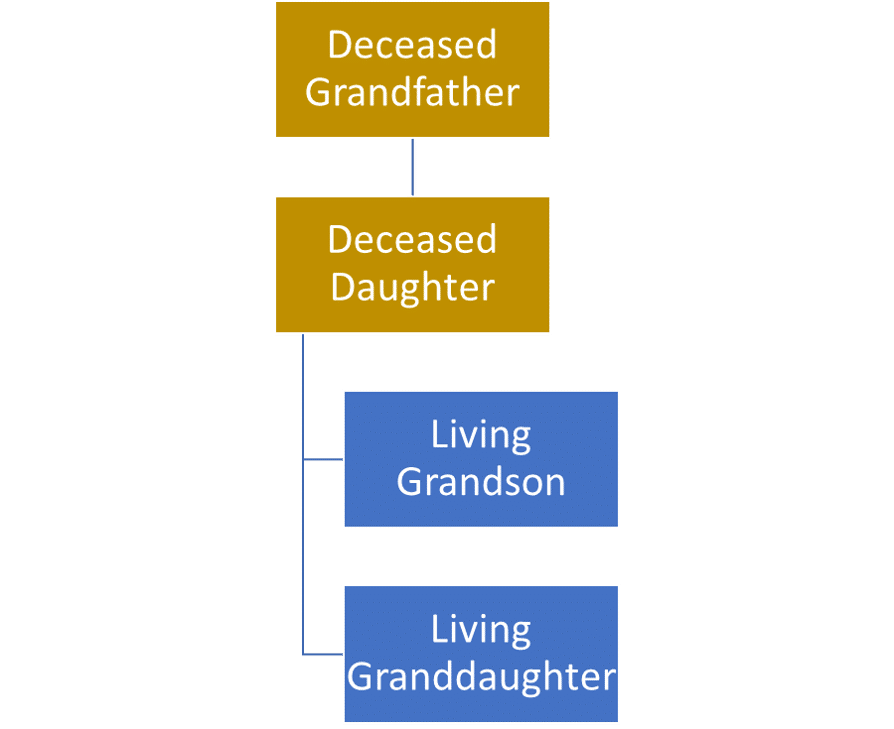
In this case the living grandchildren would inherit through their line.
What are the Advantages of Jointly Administered Probate Cases?
- Court Costs: The filing fee for a single or joint probate case is the same.
- Publication Costs: Probate cases require publication. A joint probate is almost ½ the cost of filing two separate probate cases.
Top Companies Producing in Oklahoma
Call: (405) 418-4222
Call: (405) 252-8100
Call: (405) 310-2660
Call: (918) 995-7743
Call: (405) 478-8770
Owner Relations
Owner Relations
Call: (918) 894-4440
Call: (281) 891-1000
Owner Relations
Owner Relations
Owner Relations
Owner Relations
Owner Relations
Owner Relations
Call: (972) 980-9901
Owner Relations
Owner Relations
Owner Relations
Call: (806) 376-2611
Call: (918) 588-7000
Owner Relations
Call: (713) 650-8500
Call: (405) 896-8500
Call: (918) 584-7611
Owner Relations
Call: (713) 452-1700
Call: (405) 310-7070
Call: (405) 533-3800
Call: (918) 493-7700
Call: (800) 945-5426
Hear interview from Mineral Rights Podcast:
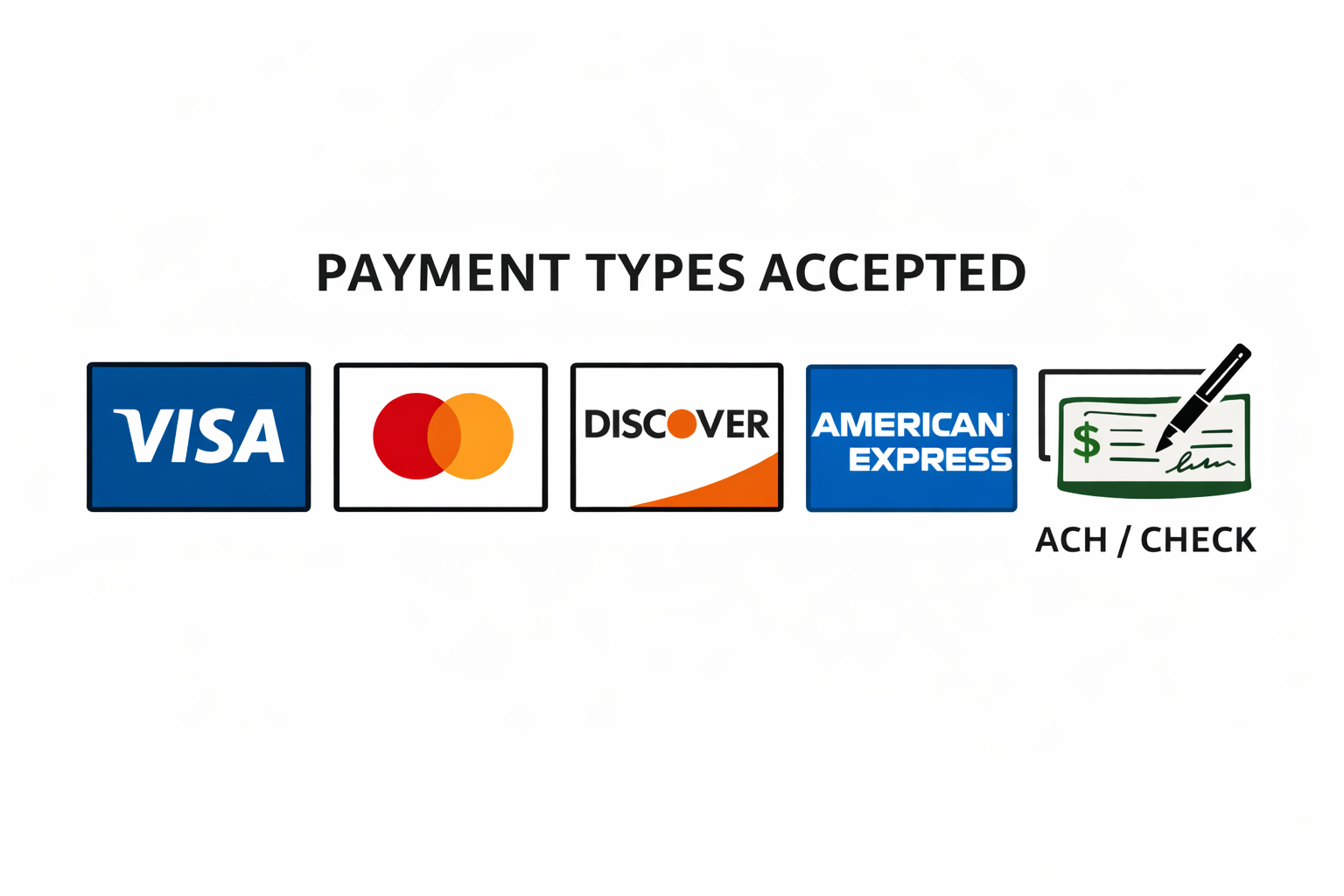
We accept credit and debit cards. We can also accept checks by mail or electronically.
Why Choose Winblad Law
Richard Winblad: Oklahoma Mineral Title Counsel
When resolving complex mineral title issues, local court experience and an understanding of the oil and gas industry are essential. Richard Winblad provides a focused approach to probate and title curative matters for out-of-state heirs and legal counsel.
- Decades of Legal Excellence: Admitted to the bar in 1992, Richard holds an AV Preeminent® Rating*—the highest possible peer rating for ethical standards and legal ability. Richard Winblad lawyers and law firms – Martindale.com
- Mineral Industry Involvement: A member and leadership positions of the National Association of Royalty Owners (NARO), Richard has presented at both the Oklahoma State chapter and national conventions.
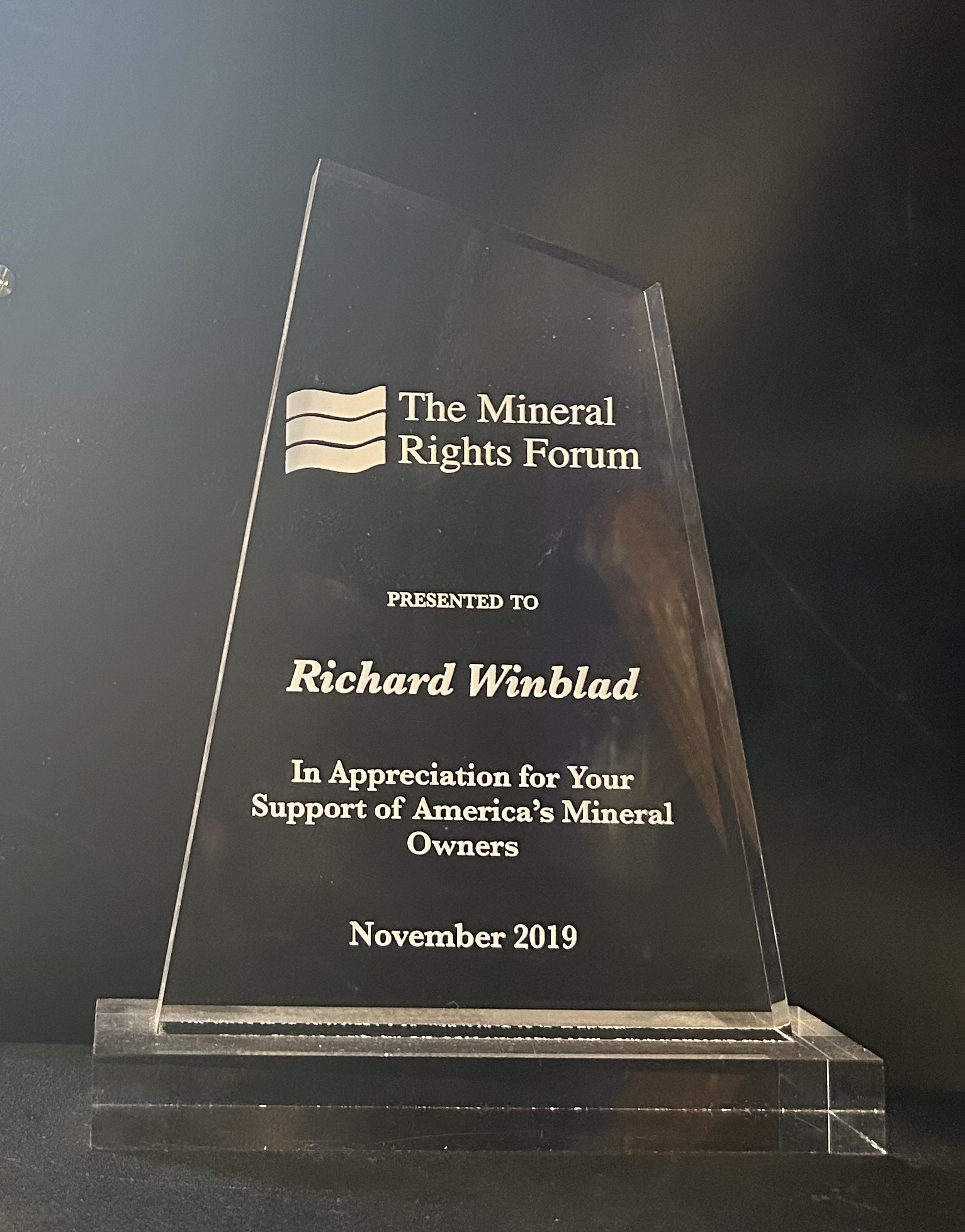
- Recognized Authority: Featured guest on The Mineral Rights Podcast (Episode 85), discussing the complexities of Oklahoma mineral probate.
- Concentrated Practice: For over a decade, Richard has focused on clearing title several cases involved through multiple generations.
*AV®, AV Preeminent®, Martindale-Hubbell Distinguished and Martindale-Hubbell Notable are certification marks used under license in accordance with the Martindale-Hubbell certification procedures, standards and policies. Martindale-Hubbell® is the facilitator of a peer review rating process. Ratings reflect the anonymous opinions of members of the bar and the judiciary. Martindale-Hubbell® Peer Review Ratings™ fall into two categories – legal ability and general ethical standards. It is not a certification of expertise for any particular area of practice.