
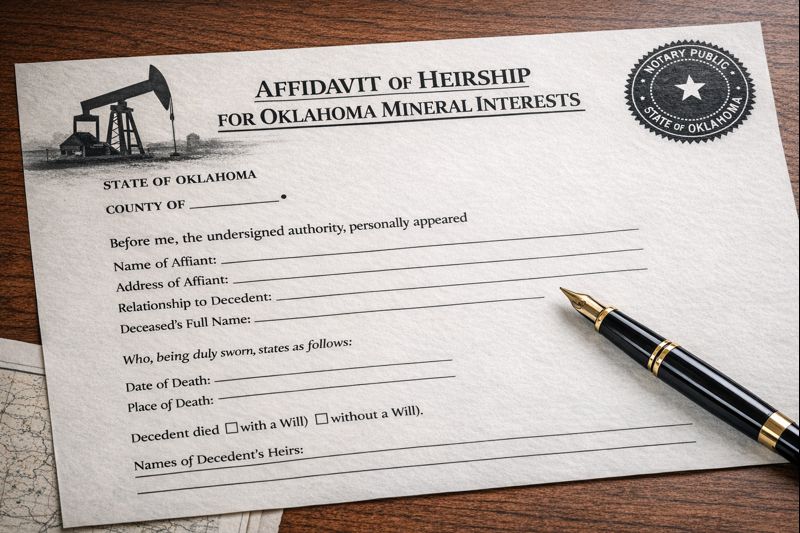
An Affidavit of Heirship is a powerful yet often misunderstood tool used to link the chain of title for deceased mineral owners without a formal court proceeding. Essentially, it is a sworn legal document used to identify heirs and establish ownership of oil and gas interests when an individual dies without a will or when a full probate is not immediately pursued. While it is frequently utilized as a streamlined alternative to navigate the complexities of mineral rights transfers, understanding its specific uses and inherent limitations is critical for any heir or beneficiary.
Drawing on our focused experience in Oklahoma mineral probate, this guide explores how an affidavit can help you claim royalties while highlighting the risks—such as the failure to create marketable title—that often necessitate a more formal legal solution.
Have Questions? Schedule a Free Telephone Conference

Using an Affidavit of Heirship for Oklahoma Mineral Rights
In Oklahoma, the use of an Affidavit of Heirship is governed by specific statutes (primarily 16 O.S. § 67) that distinguish it from general “small estate” affidavits used for bank accounts or vehicles. While it is a common tool for families with concentrated practice in mineral management, Oklahoma law treats it as a “waiting game” for full legal validity. That is why many chose to obtain quicker certainty with a mineral rights probate. See Here
The 10-Year Marketable Title Rule
The most critical thing for an Oklahoma mineral owner to understand is the Marketability Gap.
- Immediate Use: Once recorded, an affidavit may allow an oil and gas company to release “suspended” royalty payments or sign a new lease with you. This is a business decision made by the operator based on their risk tolerance.
- The 10-Year Threshold: Under Oklahoma law, an Affidavit of Heirship does not create marketable title—the kind of “clean” title required to sell minerals—until it has been on file with the County Clerk for ten (10) years.
- The Risk: During that decade, the title is considered “rebuttable.” If a lost heir or a conflicting will surfaced, your claim could be challenged.
When to Use an Affidavit in Oklahoma
Because of our focused experience in this jurisdiction, we typically see affidavits used successfully in these specific scenarios:
- Small Interests: When the cost of a formal probate would exceed the value of the mineral interest.
- Unclaimed Royalties: To satisfy an operator’s requirements to move funds out of “suspense” and into your pocket.
- No Contradictory Wills: When there is absolute certainty regarding the family tree and no chance of a hidden will being probated later.
Oklahoma Statutory Requirements
To even begin the 10-year clock, the affidavit must meet strict criteria under 16 O.S. § 67:
- The “Severed” Rule: It only applies to “severed” mineral interests (minerals owned separately from the surface).
- Attachment of Will: If the decedent had a will that was never probated in Oklahoma, a copy must be attached to the affidavit.
- Under 16 O.S. § 67, if the decedent had a Last Will and Testament that was never probated in Oklahoma, a copy of that Will must be attached to the Affidavit of Heirship. While the law requires the attachment, it does not explicitly state the outcome if the Will disagrees with the affidavit. This creates a point of uncertainty in Oklahoma title standards: Does title pass to the heirs via intestacy or to the devisees under the Will?
- In practice, the “Mirror Will” scenario often provides a strategic path forward for mineral owners: The Concept: A “Mirror Will” is one where the distribution listed in the Will exactly matches Oklahoma’s laws of intestacy. For example, if a decedent was unmarried and the Will leaves everything to their three children in equal shares, the Will “mirrors” what the law would provide anyway.
- The Analyst’s Perspective: Division order analysts are inherently risk-averse. Their primary concern is that a “hidden” Will might surface that grants the minerals to an unexpected party, such as a charity or a non-relative. The Practical Advantage: Attaching a Will that mirrors the affidavit provides a significant “comfort factor” for the oil company. It demonstrates that regardless of whether the minerals pass via the Will or via heirship, the result is the same. While an unprobated Will is technically “ineffectual” to move title on its own (per Yeldell v. Moore), showing the analyst that there is no conflict between the family tree and the decedent’s wishes is often the catalyst needed to move funds out of suspense.
- Personal Knowledge: The person signing (the affiant) must have personal knowledge of the family history.
- Recording: It must be filed in the land records of the specific Oklahoma county where the minerals are located.
Practical Tips for Small Mineral Estates

My philosophy is simple: I treat your mineral inheritance like my own family’s. If I wouldn’t tell my cousin to do it, I won’t tell you to do it either.
When deciding whether to file an affidavit or pursue a full probate, consider these four key advantages:
- Establishes an Immediate Claim to the Minerals Recording an affidavit in the county land records puts the world on notice that you are the rightful successor. While it doesn’t immediately grant “marketable title” (due to the 10-year rule), it creates a rebuttable presumption of ownership under Oklahoma law (16 O.S. § 67), which is often the necessary starting point for any future legal action.
- Assists Operators and Landmen in Identifying Heirs For an oil and gas company or a landman looking to lease a section or pool a unit, an unprobated estate is a “gap” in the record. By filing an affidavit, you provide these professionals with the names and addresses they need to contact you. This often results in you being included in leasing opportunities or pooling orders that you might otherwise miss.
- Cost-Effective for Non-Producing or Marginal Interests If the mineral interests are currently “shut-in” (not producing) or are “marginal” (producing very low royalties), the cost of a formal probate may exceed the current value of the assets. In these cases, an affidavit is a financially sound way to maintain the chain of title without the immediate expense of court proceedings.
- Preserves the Option for Future Probate Filing an affidavit is not a “point of no return.” If a new well is drilled and the value of your minerals increases significantly, or if you decide to sell the interests and need to satisfy a buyer’s title requirements, you can still pursue a formal probate later. The affidavit acts as a placeholder while you wait for the asset’s value to justify the cost of a court decree.
- The “Beacon” Effect: Why an AOH is Vital for Leasing and Pooling
- Beyond clearing title for royalties, the Affidavit of Heirship (AOH) serves as a critical communication tool. It acts as a beacon for landmen and operators working in the area.
- Ensures You Are “Findable”: If minerals remain in the name of a deceased ancestor, you are essentially invisible to the industry. Filing an AOH puts your name and address in the county’s cross-index. When a landman creates a “runsheet” for a new well, they will find you instead of listing the interest as “Address Unknown.”
- Protects Your Rights in Pooling: In Oklahoma, the Corporation Commission requires operators to make a “diligent effort” to locate owners. By having your AOH on file, you ensure you receive the certified mail for Pooling Applications. This allows you to choose your royalty and bonus options—preventing the operator from defaulting you into the lowest available tier.
- No Shield Against Probate: It is important to remember that filing an AOH does not prevent a later probate. It is a placeholder, not a permanent legal shield. If a family member or creditor opens a probate case later, that court decree will legally supersede whatever was written in your affidavit.
Conclusion: A Strategic Bridge
Because of our focused experience in Oklahoma mineral law, we often view the Affidavit of Heirship as a “bridge” or “band-aid” for small estates—it secures your place in the records today while keeping your legal options open for tomorrow.
Technical FAQ: Understanding the Legal Framework
This section addresses the technical nuances of using an Affidavit of Heirship in Oklahoma, drawing on statutory requirements and established title standards.
What are the statutory requirements for an Affidavit of Heirship in Oklahoma? To establish the “10-year clock” for marketable title, the affidavit must comply with 16 O.S. § 67, titled Acquiring a Severed Mineral Interest from Decedent – Establishing Marketable Title. The document must be recorded in the county where the minerals are located and include a legal description of the interest. If the decedent had a will that was not probated in Oklahoma, a copy must be attached to the affidavit.
What is the legal effect of attaching an unprobated will to the affidavit? This is a point of significant legal uncertainty. Under Oklahoma law (Title 16 O.S. § 67, Comment 4), a will is considered “wholly ineffectual” to pass title to real property, including mineral or leasehold interests, until it is formally admitted to probate. Furthermore:
- No Time Limit: Oklahoma cases have held there is no expiration date on when a will can be filed for probate.
- Foreign Probates: A will probated in another state is ineffective in Oklahoma until proper Oklahoma ancillary proceedings are completed.
- Case Law: In Yeldell v. Moore (1954 OK 260), the court reinforced that a devisee has no right to enforce the provisions of a will that has not been probated. Therefore, simply attaching a will to an affidavit does not legally “enforce” the distributions listed in that will. This may be the case even if the Will was probated in a different state.
With this being said, it may still be worthwhile to file and AOH if a probate is financially impractical.
Why did the oil company accept my affidavit for a lease but refuse to pay royalties? It is not uncommon for a company to request an Affidavit of Heirship during the leasing phase to identify potential heirs for pooling or leasing purposes. However, the standards for paying out royalties are often stricter. A company’s division order department may require a formal probate to ensure “marketable title” before releasing large sums of suspended funds, as the affidavit alone does not protect the company from competing claims by unknown heirs.
Do I need to file the affidavit with the county, or just send it to the company? Often, oil and gas companies will request an affidavit for their “internal use” only. However, to begin the 10-year statutory period for marketable title in Oklahoma, the affidavit must be filed of record with the County Clerk. Relying on an internal company document provides you with no long-term title protection.
The “New Operator, New Rules” Reality
In the oil and gas industry, ownership requirements are not universal. A change in operator—whether through a company merger, an acquisition, or a landman’s new title opinion—often brings a new set of standards for what constitutes “acceptable” proof of ownership.
It is frustratingly common for an heir to have a working relationship with one operator for years based on an Affidavit of Heirship, only to have a new operator “supend” the royalties and demand a formal probate.
Glossary of Terms: Oklahoma Mineral Interests
- Affiant: The person who signs the Affidavit of Heirship, swearing that the facts contained in the document are true based on their personal knowledge.
- Affidavit of Heirship: A document used to claim a right to inherit minerals interestes.
- Ancillary Probate: A legal proceeding required when a person dies owning property in a state (like Oklahoma) other than where they lived. Even if a probate was completed in another state, an ancillary probate is usually needed to move the Oklahoma title.
- Chain of Title: The historical “paper trail” of ownership for a piece of property. An Affidavit of Heirship is used to “link” a deceased owner to their living heirs in this chain.
- Cloud on Title: Any document, claim, or unreleased lien that casts doubt on the ownership of real estate. An unprobated estate is considered a “cloud” that may prevent a sale.
- Devisee: A person who receives real estate or mineral interests through a will. (Note: Until a will is probated in Oklahoma, a devisee’s rights are not legally enforceable).
- Division Order: A document sent by an oil company that confirms the decimal interest of an owner and authorizes the payment of royalties.
- Marketable Title: A title that is free from reasonable doubt and is “clear” enough that a person can sell the interest to a buyer at fair market value. In Oklahoma, an Affidavit of Heirship does not achieve this status for 10 years.
- Pooling Order: An order from the Oklahoma Corporation Commission that allows an operator to develop a drilling unit even if some owners haven’t signed a lease.
- Severed Mineral Interest: Ownership of the oil, gas, and other minerals that has been legally separated from the ownership of the surface of the land.
- Suspense: A holding account where an oil company places royalty money when there is a question about who owns the minerals. The money stays “in suspense” until the title is cleared.
Checklist: What You’ll Need for an Oklahoma Affidavit of Heirship
To prepare a valid and effective Affidavit of Heirship under Oklahoma law (16 O.S. § 67), you should gather the following information and documentation:
- Decedent’s Information: Full legal name, last known address, and date of death.
- Death Certificate: A copy of the official death certificate to verify the date and location of passing.
- The Will (If applicable): In Oklahoma, if the decedent had a will, a copy must be attached to the affidavit even if the will is not being formally probated.
- Marital History: A complete list of the decedent’s marriages and divorces, including dates and the names of spouses.
- Family Tree Details: Names and current addresses for all children (biological or adopted) and grandchildren.
- Legal Description of Minerals: The specific Section, Township, and Range for the minerals. This is typically found on old deeds, leases, or recent pooling orders.
- A Qualified Affiant: In Oklahoma, the person signing the affidavit (the affiant) can be a family member or an heir, provided they have personal knowledge of the family history. Unlike some other states—such as Texas—Oklahoma does not require the signer to be a “disinterested” party.
- County Recording Fees: Be prepared for the filing fees required by the County Clerk in each county where the mineral interests are located.
- Margin Guidelines and Filing Fees: Generally, document presented for filing must have a 2″ top and 1″ side/bottom margins. Legal or letter sized accepted. The fee is currently $18 for first and $2 for subsequent pages. Documents not confirming to margin guidelines are charged a $25 first page and $10 additional page fee.
Serving Mineral Owners for All 77 Oklahoma Counties
| Adair | Alfalfa | Atoka | Beaver | Beckham |
| Blaine | Bryan | Caddo | Canadian | Carter |
| Cherokee | Choctaw | Cimarron | Cleveland | Coal |
| Comanche | Cotton | Craig | Creek | Custer |
| Delaware | Dewey | Ellis | Garfield | Garvin |
| Grady | Grant | Greer | Harmon | Harper |
| Haskell | Hughes | Jackson | Jefferson | Johnston |
| Kay | Kingfisher | Kiowa | Latimer | Le Flore |
| Lincoln | Logan | Love | Major | Marshall |
| Mayes | McClain | McCurtain | McIntosh | Murray |
| Muskogee | Noble | Nowata | Okfuskee | Oklahoma |
| Okmulgee | Osage | Ottawa | Pawnee | Payne |
| Pittsburg | Pontotoc | Pottawatomie | Pushmataha | Roger Mills |
| Rogers | Seminole | Sequoyah | Stephens | Texas |
| Tillman | Tulsa | Wagoner | Washington | Washita |
| Woods | Woodward |
Peer Recognized for Professional Excellence
Our commitment to providing clear, honest guidance—treating every client with the same integrity I would show a member of my own family—is reflected in my AV Preeminent® peer review rating from Martindale-Hubbell.
This rating is the highest distinction a lawyer can achieve and is a testament to the fact that my fellow attorneys and members of the judiciary rank my work at the highest level of professional excellence.*
Mandatory Disclaimer
Note on Ratings: AV®, AV Preeminent®, Martindale-Hubbell Distinguished and Martindale-Hubbell Notable are certification marks used under license in accordance with the Martindale-Hubbell certification procedures, standards and policies. Martindale-Hubbell® is the facilitator of a peer review rating process. Ratings reflect the anonymous opinions of members of the bar and the judiciary. Martindale-Hubbell® Peer Review Ratings™ fall into two categories – legal ability and general ethical standards. This is not a certification of any speciality.