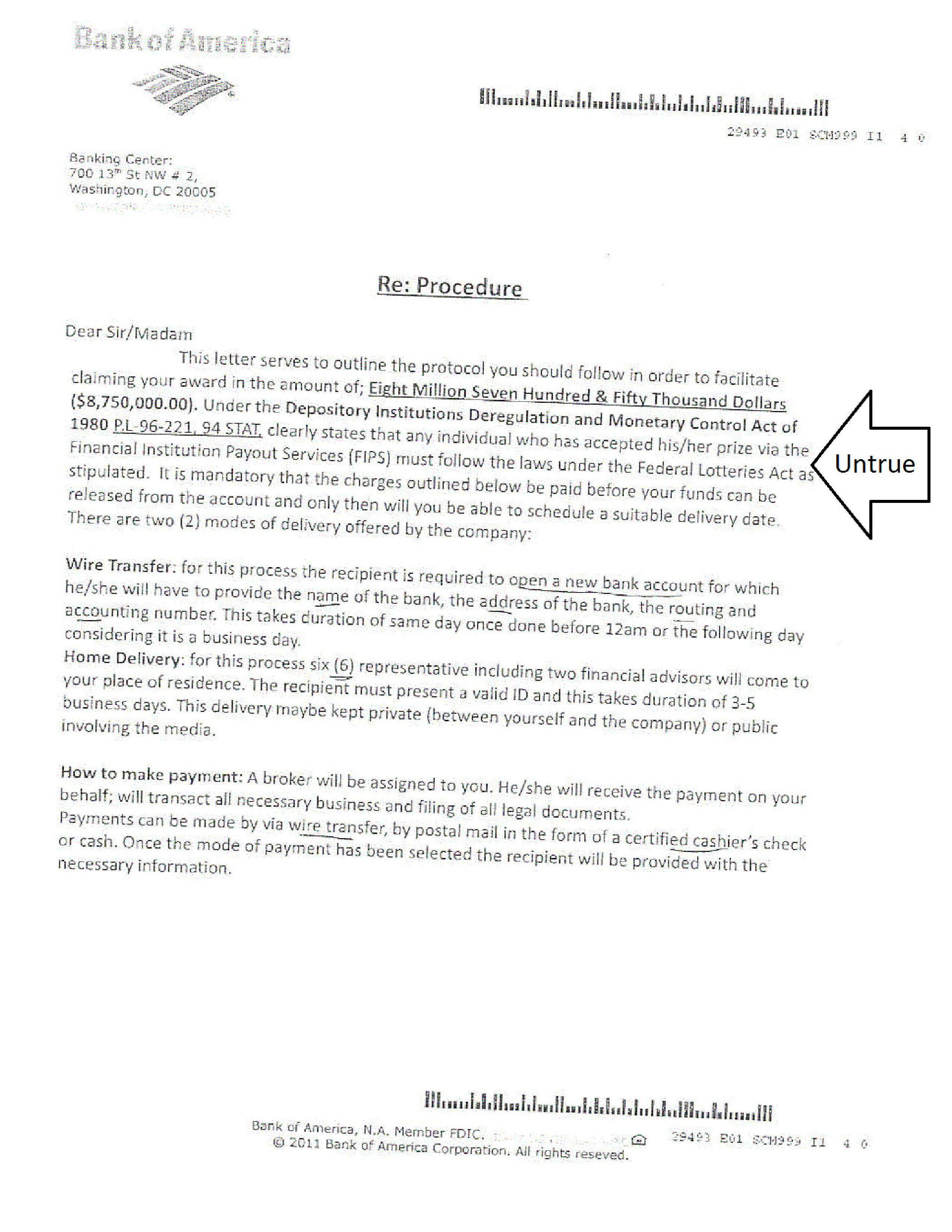
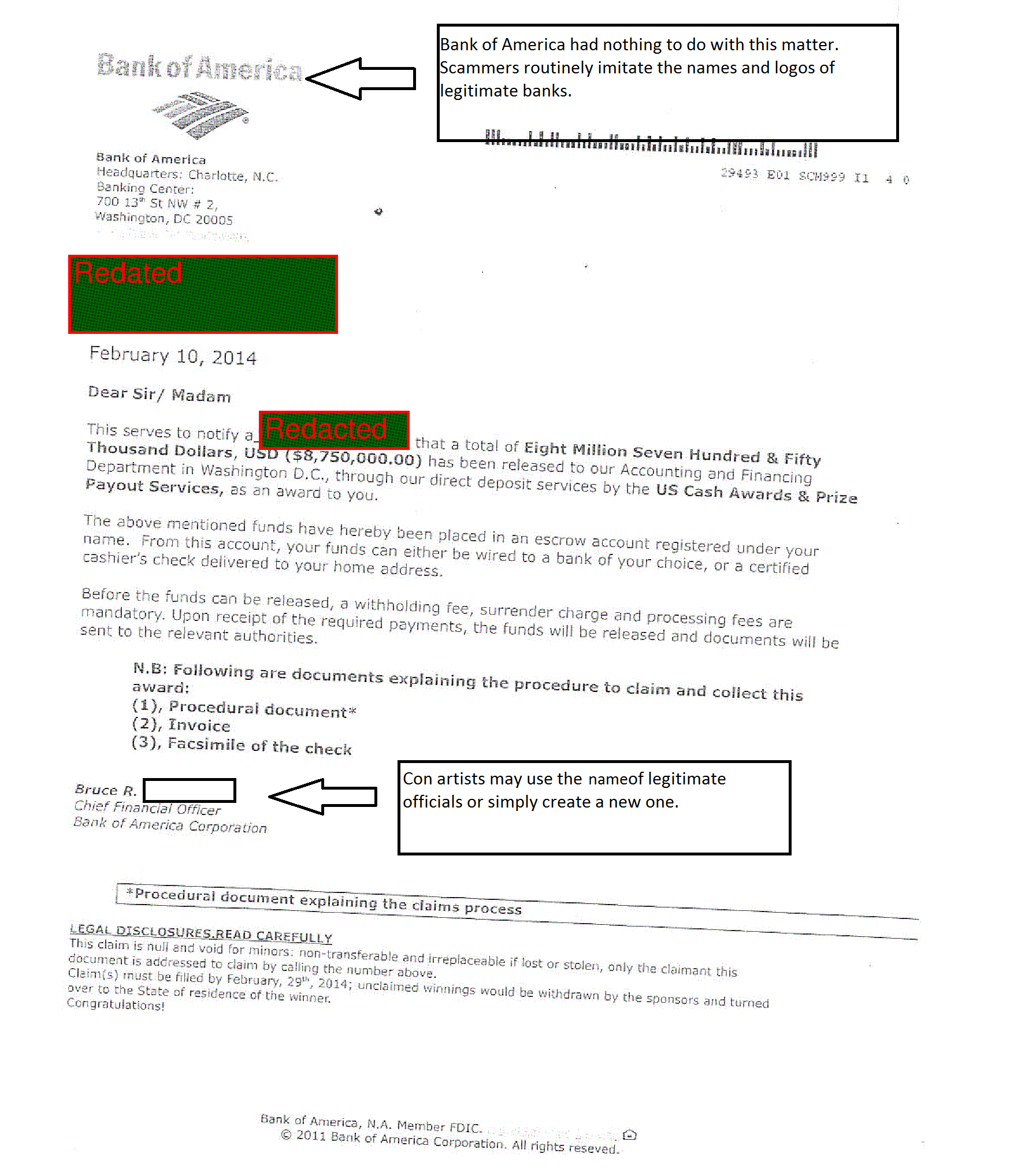
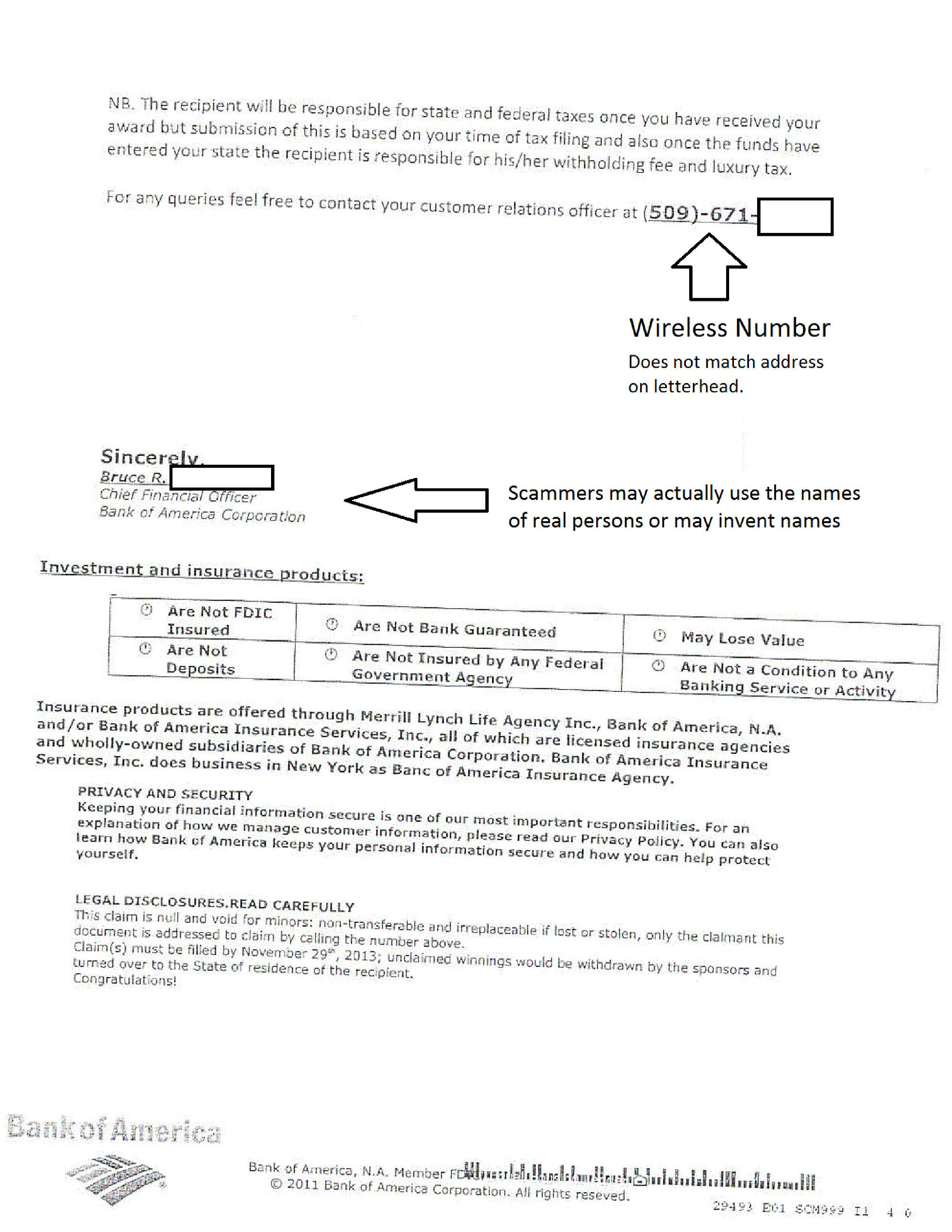
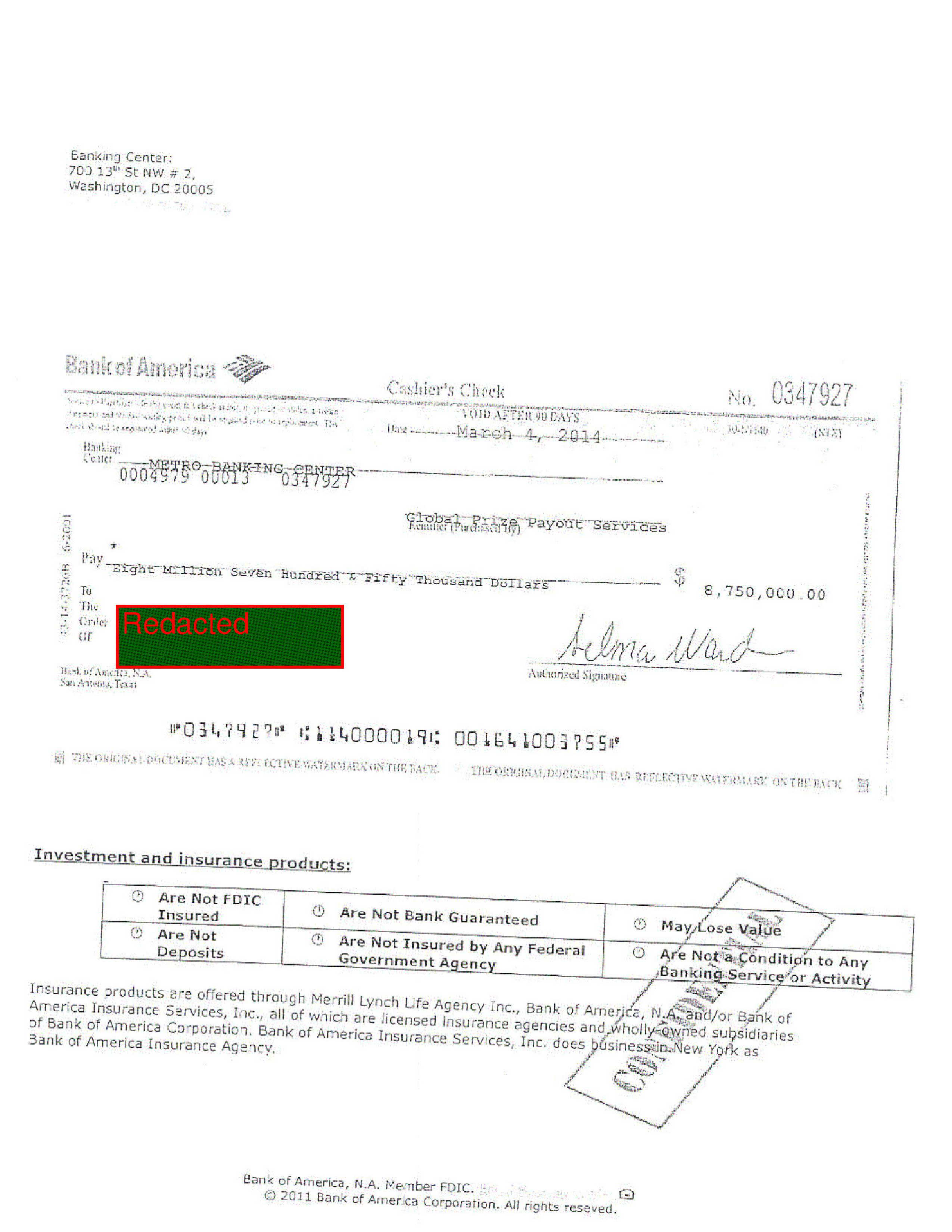
Don’t be fooled. The lottery scam begins with a bold announcement. Victims are contacted by telephone, email or mail. (A sample of a letter is provided below). The pitch is convincing. The con artists are polished and will pretend to be bank officers, IRS employees, law enforcement and company officials. There are numerous variations of the scam and they generally take on several phases which may be as follows:
The initial pitch will go something like this:
We are so very pleased to inform you that you have won the XYZ Lottery. We have $8.75 million ready to disburse to you. We just need to have you pay the taxes so that the funds can be sent. …
The victim is instructed that before the prize can be collected that taxes must be paid. Various methods of transferring the money are used. Here are a few of them:
Legitimate sweepstakes do not require winners to pay any taxes, fees or costs in advance. If a victim falls for an initial scam another fee, charge or tax is sure to follow. They will apologize for forgetting a fee, charge, another tax or other reason to send more money. It is not unusual for victims to repeatedly send money.
Short advertisement.
On rare occasions the criminals may return some money only to keep their prey playing along. A return of a small portion of the money lost can help regain credibility of the swindlers. One incident involved a victim who had given hundreds of thousands of dollars to the charlatans. The crooks sent the target first-class tickets to Spain. The gentleman was taken to a room with piles of money and told he would take as much as he wanted. He took a couple of thousand and was told how the money would be “invested” to claim the winnings. He returned to the United States and sent the bad guys hundreds of thousands more.
Once the victim refuses to cooperate by sending more money the con artists may change tactics. Sometimes a new “representative” will be assigned to fix the problem. The new fraudster will explain that certain fees or taxes were missed. At other time law enforcement officers will be impersonated. The fake cops may ask for money to pay costs or may encourage the victim to cooperate with the new representative. These criminals have been known to use the names of real police officials then set up a telephone number which appeared to be a local number. A technique known as caller id and location spoofing. The criminal can create an account that provides a false area code or caller id.
Again, the fraud involves convincing the victim that the money previously lost can be recovered.
If the victim steadfastly refuses to send additional funds the con artists may pretend to be law enforcement and threaten to arrest if he refuses to cooperate. They may claim that a warrant has been issued for their arrest but they can post bail to avoid going to jail. There may be a threat of turning the victim over to the authorities unless demands for payment are made. There may be threats of violence against the target as the CBS news story shows.
People who fall into the traps of these thieves often find their bank accounts taken over. The villains are not shy about stealing from bank accounts, diverting social security payments or identity theft. With information they obtain it is easy to impersonate their prey.
Bank of America did not have anything to do with the scam. The criminals impersonated bank officers and used BOA’s logo and materials to create the forgery.
To understand the risk of dying without a plan, we can look at one of…
Mineral probates in Oklahoma often involve families who did the “right things” during life: they…
Why are my Oklahoma oil royalties in suspense? If you have inherited mineral rights in…
Garfield County, anchored by Enid, is a powerhouse in the Northern Oklahoma oil and gas…
Ellis County, located on the far western edge of Oklahoma, is a crucial part of…
Roger Mills County, located on the western edge of Oklahoma, sits atop the prolific Anadarko…
This website uses cookies.