Wills, Trusts, or Statutory Avoidance: Which is Better in Oklahoma?
The most common question clients ask is: “Which is better, a Will or a Trust?” In Oklahoma, the answer isn’t found in a one-size-fits-all form. It is found by looking at your assets—specifically your home, your vehicles, and your Oklahoma mineral rights—and deciding how much of the “probate court system” you want your family to experience.
At Winblad Law, we provide concentrated practice in helping families navigate these three distinct paths.
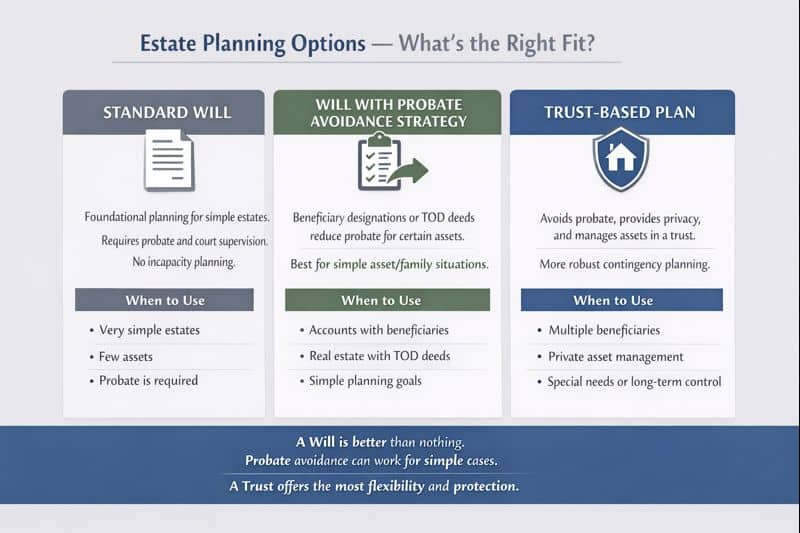
Many people are surprised to learn that a Will does not avoid probate. In fact, a Will is a formal request for a judge to open a probate case.
A Trust is a separate legal entity created during your lifetime to hold your assets. We often describe a Trust as a Wagon.
For many Oklahomans, a Trust feels like “too much engine” for their needs, but they still want to spare their family the headache of probate. This is where Statutory Probate Avoidance comes in.
Oklahoma law provides specific, streamlined tools that allow assets to transfer automatically by law, bypassing both the Will and the Trust.
| Feature | Last Will & Testament | Statutory Avoidance | Revocable Living Trust |
| Avoids Probate? | No. | Yes. | Yes. |
| Privacy | Public Record | Private | Private |
| Upfront Cost | Lowest | Low | Moderate |
| Maintenance | None | Low (Update Deeds/Forms) | Moderate (Funding) |
| Incapacity Protection | No | No | Yes. |
| Mineral Rights | Requires Probate | Deed per county | One “Wagon” covers all |
The “best” plan is the one that actually works when your family needs it.
With concentrated practice in Oklahoma estate law, we help you coordinate these tools so that your “wagon” is never empty and your “direct path” is clearly marked.
Ready to bypass the courthouse?
We can help you determine if a Statutory Probate Avoidance plan or a Living Trust is the right fit for your family and your legacy.
In the complex world of Oklahoma estate law, technical details are the difference between a secure legacy and a family legal battle. Richard Winblad brings a concentrated practice in estate planning, probate, and trust law to every client he serves, ensuring that their intentions are translated into legally sound documents.
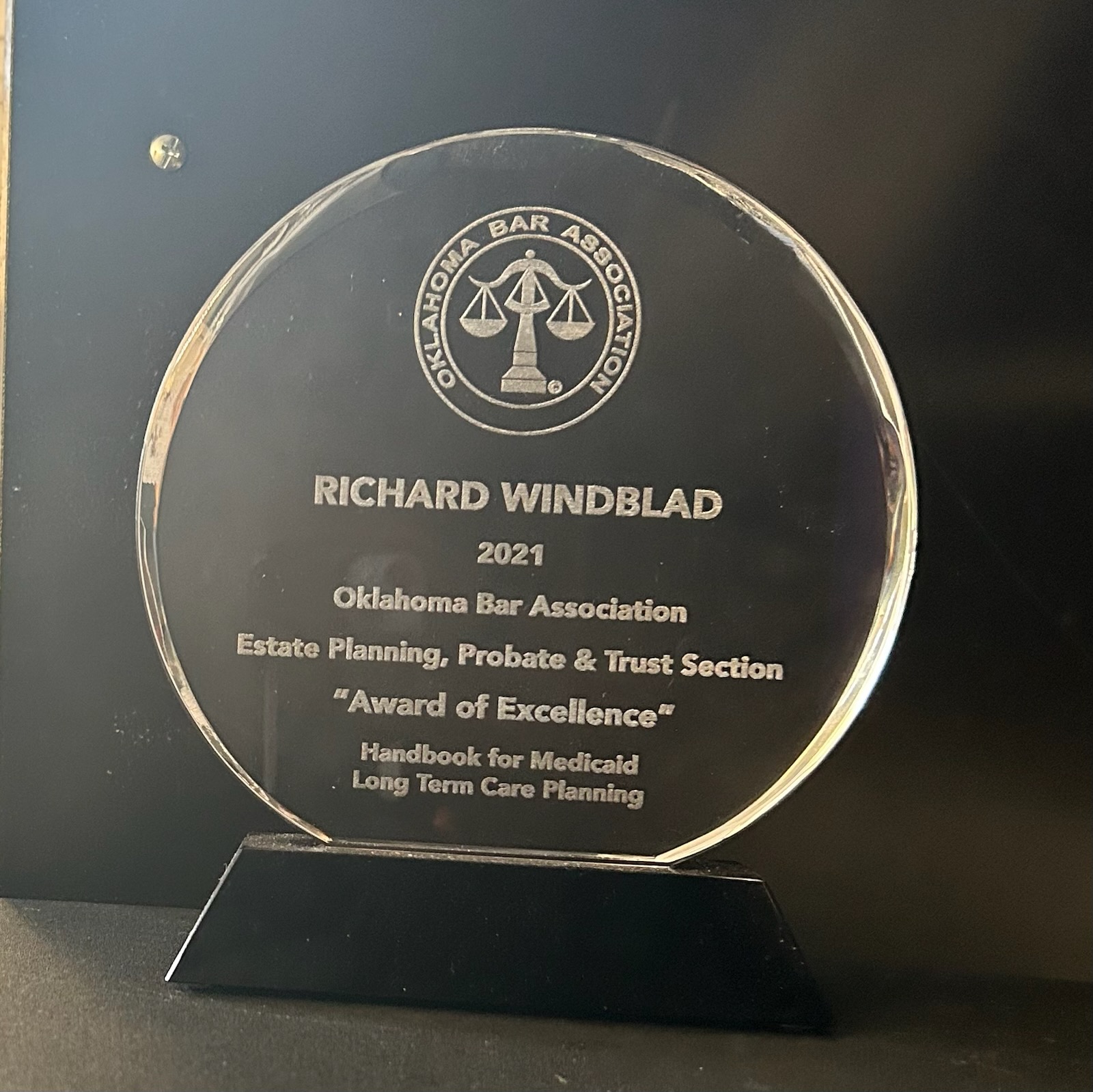
As an active member of the Oklahoma Bar Association’s Estate Planning, Probate, and Trust Section, Richard stays at the forefront of the statutes that govern the transition of assets between generations. His commitment to legal excellence earned him the “Award of Excellence” for his contributions to the professional handbook for Medicaid and Long-Term Care Planning—a vital resource used by attorneys throughout the state.
Richard is also a dedicated educator within the legal profession. He has authored and taught Continuing Legal Education (CLE) classes for fellow Oklahoma Bar members, sharing his insights on navigating the intricacies of probate and trust management. Beyond his work with other attorneys, he frequently presents to non-profit organizations, professional groups, and the public to help Oklahomans understand that a verbal promise cannot substitute for a properly executed plan.
AV Preeminent is a certification mark used under license in accordance with the Martindale-Hubbell certification procedures, standards and policies. Martindale-Hubbell® is the facilitator of a peer review rating process. Ratings reflect the anonymous opinions of members of the bar and the judiciary. Martindale-Hubb1ell® Peer Review Ratings™ fall into two categories – legal ability and general ethical standards.
No. In Oklahoma, a Will is simply a roadmap for a judge. For a Will to be effective, it must be admitted to probate. If you own a home or mineral rights in your name alone, your family will likely face a 6-to-12-month public court process even with a valid Will.
This is a method of using specific Oklahoma statutes to transfer property automatically upon death without the need for a Trust. It involves filing specialized “Transfer on Death” (TOD) documents for your real estate, vehicles, and accounts while you are still alive.
Under Oklahoma Statute 47 O.S. § 1107.5, you can name a beneficiary for your car or boat.
Yes. Under the Nontestamentary Transfer of Property Act (58 O.S. § 1251), you can file a Transfer on Death Deed specifically for mineral interests. This is often the most efficient way to avoid Oklahoma Mineral Probate if your minerals are located in just a few counties.
Important Note: A TOD Deed must be filed with the County Clerk before you pass away. If it is sitting in a desk drawer when you die, it has no legal effect.
No—and doing so might actually make the document invalid. In Oklahoma, a notary only verifies your identity; they do not make a document a valid Will.
Using DIY letters or store-bought kits often leads to expensive failures. For real-world examples, see The Danger of DIY Estate Planning: Why Simple Forms Often Fail.
This is known as an “unfunded” Trust. Any asset left out of your Trust (and not covered by a TOD designation) must go through probate. We provide concentrated practice in “funding” to ensure your “wagon” is never empty when your family needs it.
While TOD designations are excellent for simple estates, a Revocable Living Trust provides superior protection if you become ill. A TOD designation only works when you die; a Trust “holds the handle” of your wagon if you become incapacitated and can no longer manage your affairs while alive.
No—not during your lifetime. A Revocable Living Trust is what the IRS calls a “grantor trust.” For tax purposes, the IRS essentially considers the Trust to be “invisible.”
No. This is one of the primary reasons people choose a Trust over a Will.
This website uses cookies.