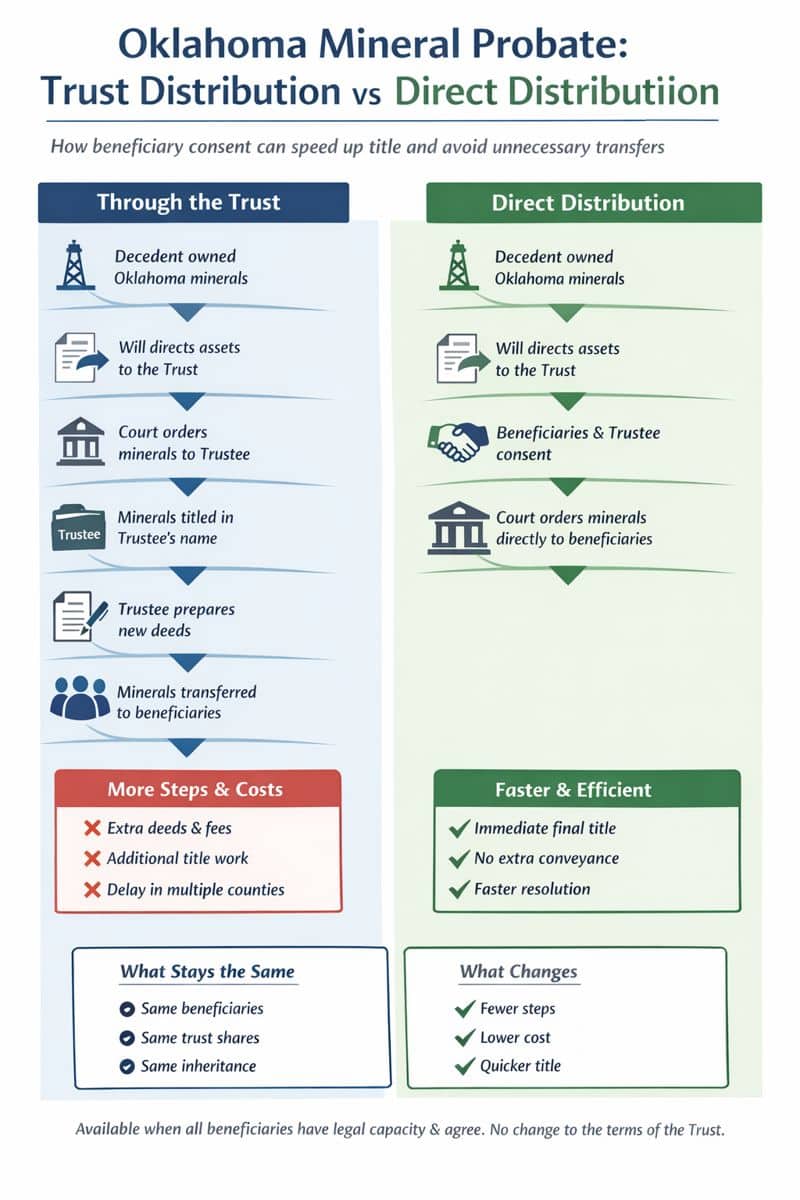
Bridging the gap between probate and final ownership by avoiding an unnecessary transfer through a trust.
Mineral probates in Oklahoma often involve families who did the “right things” during life: they created a revocable trust, paired it with a pour-over Will, and intended to make administration as simple as possible.
Even with good planning, mineral interests frequently still require probate. The issue is not the trust itself, but how mineral title moves at the very end of the probate process.
The Default Result Under a Pour-Over Will
When a Will contains a pour-over provision, the standard result at the conclusion of the probate is that probate assets are distributed to the trustee of the trust.
For Oklahoma mineral interests, that means the court’s order typically transfers the minerals into the name of the trustee, even when the trust immediately requires those same minerals to be distributed out to the beneficiaries.
The trustee must then take a second step: preparing and recording deeds or other conveyances to move the minerals from the trust to the beneficiaries.
The trust becomes a temporary stopping point, even though everyone already agrees on who should ultimately own the minerals.
Why This Extra Step Causes Delay and Expense
That additional transfer is not just theoretical. It often results in:
When minerals are located in several counties, the cost and time involved can multiply quickly.
A Faster Way to Resolve Title When Everyone Agrees
When all beneficiaries entitled to receive distributions under the trust are in agreement and have the legal capacity to consent, there is a simpler alternative.
Instead of distributing the minerals to the trustee and then back out to the beneficiaries, the beneficiaries may agree that the probate court’s order will distribute the mineral interests directly to them in their respective shares, exactly as the trust provides.
This does not change who inherits. It does not rewrite the trust. It simply allows the probate to end with the minerals already in their final ownership.
How This Streamlines Oklahoma Mineral Probate
Using this approach can:
In many cases, it allows the probate to truly conclude with final title in place.
When This Option Is Available
This streamlined approach works when:
When those conditions are met, Oklahoma probate courts can issue orders distributing mineral interests directly to the beneficiaries, avoiding the extra trust transfer entirely.
Why Addressing This Early Matters
This issue often arises at the very end of a probate, when families are expecting things to wrap up. Addressing it early can avoid delays, frustration, and avoidable expense.
For estates with Oklahoma mineral interests, especially those spread across multiple counties, a small procedural decision can make a meaningful difference in how quickly and cleanly title is resolved.
If you are administering a probate involving a pour-over trust and Oklahoma minerals, this is a conversation worth having before the final order is entered.
If the minerals are ultimately going to the beneficiaries, why involve the trust at all?
In many cases, the trust is involved because the decedent’s Will contains a pour-over provision naming the trust as the recipient of probate assets. That provision controls the default path of distribution and cannot simply be ignored, even when everyone agrees on the final beneficiaries.
When the probate court is asked to distribute assets in a manner different from the default pour-over language, it is important to clearly show two things: first, that Oklahoma law permits this type of agreed-upon distribution, and second, that all beneficiaries entitled to receive the assets under the trust have knowingly consented.
Properly documented beneficiary consents and trustee joinder allow the court and title examiners to see that the trust’s dispositive scheme is being followed, even though the assets are distributed directly to the beneficiaries. This ensures the distribution is both legally permissible and reliable for title purposes, while avoiding an unnecessary extra transfer through the trust.
Why do Oklahoma mineral interests still go through probate if there is a trust?
Mineral interests are interests in real property. If they were not deeded into the trust during life, they remain titled in the decedent’s name and must be addressed through probate, even if a revocable trust exists.
What happens by default when a Will pours assets into a trust?
Under a standard pour-over Will, probate assets are distributed to the trustee of the trust at the conclusion of probate. For minerals, that typically means title is first transferred into the name of the trustee.
Why is that extra step a problem?
Once the minerals are titled in the trust, the trustee must then execute additional documents to transfer the minerals out to the beneficiaries. This often means more deeds, more recordings, more title work, and more delay, especially when minerals are located in multiple Oklahoma counties.
Can the minerals be distributed directly to the beneficiaries instead?
Yes, in many cases. If all beneficiaries entitled to distribution under the trust agree and have legal capacity, they may consent to a direct distribution from the estate to themselves in their respective shares, without first titling the minerals in the trust.
Does this change who inherits the minerals?
No. This approach does not change the inheritance or rewrite the trust. The beneficiaries receive exactly what the trust provides. The difference is procedural, not substantive.
Is court approval required for this approach?
The probate court still issues the final order of distribution. The difference is that the order distributes the minerals directly to the beneficiaries rather than to the trustee, based on the beneficiaries’ written consent.
Does this save time and money?
In many cases, yes. Avoiding an extra transfer can reduce legal fees, recording costs, and title expenses, and can result in faster resolution of ownership and pay status with operators.
When should this be addressed during probate?
Ideally, early in the process and certainly before the final decree of distribution is entered. Addressing it late can still help, but early planning avoids delays at the end of the case.
Why didn’t the Will just leave the mineral interests directly to the children?
When the estate plan was created, the trust was used to account for contingencies that a simple Will cannot easily handle. At that time, there may have been concerns about a child predeceasing the parent, a grandchild with special needs, creditor protection, or other family circumstances that were uncertain or unforeseen. A pour-over Will ensures assets pass into the trust so those protections apply if needed. When those contingencies do not arise and all beneficiaries are living, capable, and in agreement, the probate can sometimes be streamlined while still honoring the trust’s dispositive plan.
In the complex world of Oklahoma estate law, technical details are the difference between a secure legacy and a family legal battle. Richard Winblad brings a concentrated practice in estate planning, probate, and trust law to every client he serves, ensuring that their intentions are translated into legally sound documents.
As an active member of the Oklahoma Bar Association’s Estate Planning, Probate, and Trust Section, Richard stays at the forefront of the statutes that govern the transition of assets between generations. His commitment to legal excellence earned him the “Award of Excellence” for his contributions to the professional handbook for Medicaid and Long-Term Care Planning—a vital resource used by attorneys throughout the state.
Richard is also a dedicated educator within the legal profession. He has authored and taught Continuing Legal Education (CLE) classes for fellow Oklahoma Bar members, sharing his insights on navigating the intricacies of probate and trust management. Beyond his work with other attorneys, he frequently presents to non-profit organizations, professional groups, and the public to help Oklahomans understand that a verbal promise cannot substitute for a properly executed plan.
To understand the risk of dying without a plan, we can look at one of…
Why are my Oklahoma oil royalties in suspense? If you have inherited mineral rights in…
Garfield County, anchored by Enid, is a powerhouse in the Northern Oklahoma oil and gas…
Ellis County, located on the far western edge of Oklahoma, is a crucial part of…
Roger Mills County, located on the western edge of Oklahoma, sits atop the prolific Anadarko…
Major County is a vital component of the STACK play (Sooner Trend, Anadarko, Canadian, and…
This website uses cookies.