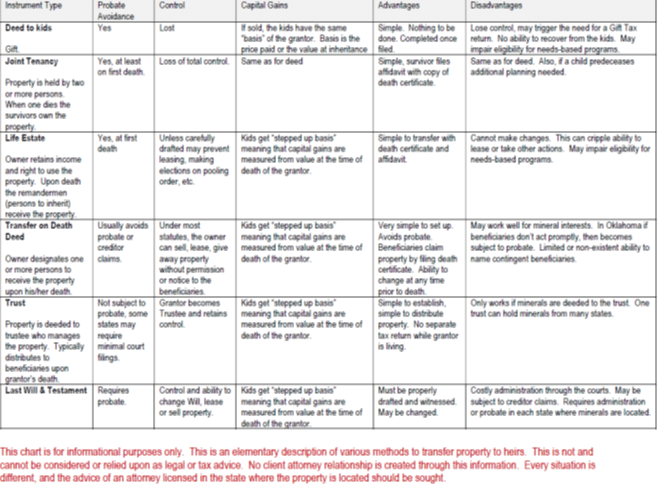
When passing on oil and gas interests, what is the best method? An inheritance of a minerals interest can be handled in various ways. What is best depends on you and your family's needs.
People often ask, “What is the best way to pass oil and gas mineral interests to a son, daughter, spouse, or grandchild?” The answer depends on your family’s unique circumstances. Options include using a Last Will, Trust, or Transfer on Death Deed. Others may consider granting a deed or creating a life estate. However, there is no one-size-fits-all solution.
The best approach is to carefully review these options with an experienced estate planning attorney, who can help tailor a plan to meet your goals and avoid unnecessary legal hurdles like probate.
Mineral ownership is distinct because it often passes through generations, preserving a family legacy. In Oklahoma, it’s common for mineral rights to trace back to a land run or homestead deed. Sometimes, surface rights were sold, but families retained the mineral rights as a connection to their land.
During the Dust Bowl, many Oklahomans who moved away kept their mineral interests with the hope that homesteading dreams will pay off. Many descendants are now benefiting from their ancestors’ forethought. As a current mineral owner, you can honor this tradition by thoughtfully planning how to pass these rights to the next generation.
This article explores common methods for transferring mineral interests, including strategies to avoid probate. While the examples primarily focus on passing rights to children, these methods also apply when leaving mineral rights to a spouse or another beneficiary.
In Oklahoma, probate is a judicial process used to settle the estate of a deceased individual (decedent). This legal procedure is necessary if the decedent had a Last Will and Testament or died without a will (intestate) and the property does not pass through a non-probate transfer, such as a Trust or Transfer on Death Deed.
The probate process involves several steps:
While probate will eventually ensure that titles are cleared and royalties are placed into pay status, it is often considered a costly and time-consuming process. For this reason, many individuals prefer to use non-probate planning tools to simplify the transfer of assets and avoid unnecessary legal headaches.
Another way to pass property is through a deed. These can be one of many forms.
1. Outright Mineral Deed
A parent can transfer mineral rights directly to a child using a quit claim mineral deed. Once executed, the child owns the property outright and is entitled to all associated income.
Potential Drawbacks:
Creditor Risks: The mineral rights may become vulnerable to the child’s creditors, bankruptcy, or claims from a divorcing spouse.
Loss of Control: The parent relinquishes all rights and decision-making power over the property.
Impact on Assistance: Transferring assets may disqualify the parent from nursing home assistance or veteran’s benefits.
Tax Implications: If the child sells the property, they may face capital gains taxes that could have been avoided. A transfer may also trigger gift tax considerations.
Joint Tenancy Mineral Deed:
A joint tenancy deed places mineral ownership into the names of two or more individuals, using language like:
“To A & B as joint tenants with rights of survivorship and not tenancy in common.”
This is common for married couples. When one owner dies, their interest automatically transfers to the surviving owner(s) by filing an affidavit.
Potential Drawbacks:
. More about Joint Tenant Deed Here.
Mineral Life Estate:
A life estate deed allows a parent (the life tenant) to retain royalties and control during their lifetime. The property is deeded to children (the remaindermen), who take ownership after the parent’s death by filing an affidavit.
Potential Challenges:
Transfer on Death Mineral Deed
A Transfer on Death (TOD) Mineral Deed is a simple and flexible way to designate beneficiaries to inherit mineral rights. The process involves signing the deed, having it witnessed, and filing it with the county land records where the minerals are located.
Key Features of a TOD Mineral Deed:
How It Works:
While a Transfer on Death Mineral Deed offers flexibility and simplicity, it has limitations that may not suit every situation. For those needing contingency planning or wanting to avoid probate complications, a trust might be a better option. Consulting an experienced estate planning attorney ensures the best approach for your family’s needs and goals.
More about Transfer on Death Deeds Here.
A trust is an effective way to hold and manage oil and gas interests, providing multiple benefits, including avoiding probate and offering protection for beneficiaries. Here’s a detailed look at how trusts work for mineral rights and oil and gas assets.
A trust is a legal arrangement where a trustee holds title to property for the benefit of designated beneficiaries. Key components include:
For individuals receiving SSI or Medicaid, a Special Needs Trust can:
A trust is a powerful estate planning tool that provides flexibility, protection, and efficiency. It’s particularly valuable for families with complex inheritance goals or vulnerable beneficiaries. A simple trust is often less expensive than the cost of probate and provides greater control over how assets are distributed.
Consulting with an experienced estate planning attorney ensures the trust is properly structured and funded to meet your family’s needs.
An LLC can be a practical tool for managing and passing down mineral interests, especially for individuals with high-net-worth or for families owning mineral rights in multiple states. Here’s a detailed look at using an LLC for mineral ownership.
A Limited Liability Company (LLC) is a legal entity that allows individuals to hold and manage assets like mineral rights. It combines the liability protection of a corporation with the operational flexibility of a partnership.
While an LLC offers liability protection, centralized management, and tax planning benefits, it is best suited for high-net-worth individuals or families with complex holdings. For most individuals, a trust is a simpler and more effective solution.
Consulting an estate planning attorney familiar with mineral rights can help determine if an LLC, a trust, or a combination of both is the right fit for your situation.
A Last Will and Testament is a legal document that allows a person (the testator) to designate how their property, including oil and gas interests, will be distributed after their death. While it offers flexibility, there are critical considerations to keep in mind when dealing with mineral rights.
Decide if the minerals should be divided equally among beneficiaries or gifted to a specific person.
More about Last Will and Testament Here.
If you choose to include mineral rights in your Will, ensure it is clear and detailed:
Specify the exact legal description of the mineral interests to avoid ambiguity.
A Power of Attorney (POA) is a vital document in managing mineral rights, particularly when the owner may face incapacity. It grants a trusted individual (the agent) the authority to act on behalf of the principal (the person creating the POA).
In such cases, the court may appoint a guardian or conservator, which is a time-consuming and costly process.
Purpose and Limitations:
A POA is only effective while the principal is alive.
It cannot be used to distribute property or handle estate matters after death.
Use in Incapacity:
If the principal becomes mentally or physically incapacitated, the agent can act on their behalf.
This authority includes signing oil and gas leases, making elections under pooling orders, or managing royalty payments.
Avoiding Guardianship:
Without a valid POA, no one would have the legal authority to manage the principal’s mineral interests during incapacity.
In today’s digital age, many legal forms, including estate planning documents, can be easily found online for free or for a nominal fee. While this may seem convenient and cost-effective, relying on these forms can lead to serious problems that may not surface until it’s too late to correct them.
With professionally prepared documents, you can rest assured that your estate plan is valid and enforceable, reducing the risk of disputes or complications.
Tailored Advice:
An attorney can provide personalized guidance based on your unique circumstances, ensuring that the documents align with your goals and comply with state laws.
Preventative Measures:
Attorneys can anticipate and address potential issues, such as contingencies for predeceased beneficiaries or tax implications.
Proper Execution:
Legal professionals ensure documents are properly executed, witnessed, notarized, and, if necessary, filed or recorded with the appropriate entities.
Peace of Mind:
There is no universal “best” way to transfer mineral interests or other property to beneficiaries. Each situation requires careful consideration of the owner’s goals, the beneficiaries’ needs and capabilities, and the available budget. Estate planning solutions must be tailored to ensure they meet these unique requirements while avoiding unnecessary complications or costs.
This article serves as an overview of the topic, offering insight into some of the methods and considerations involved in estate planning. However, it is not intended to be used as legal or tax advice. Before making any decisions or executing estate planning documents, consult with a qualified attorney who specializes in estate planning and probate. Professional guidance ensures that your plan aligns with your objectives, complies with the law, and protects your legacy.
To understand the risk of dying without a plan, we can look at one of…
Mineral probates in Oklahoma often involve families who did the “right things” during life: they…
Why are my Oklahoma oil royalties in suspense? If you have inherited mineral rights in…
Garfield County, anchored by Enid, is a powerhouse in the Northern Oklahoma oil and gas…
Ellis County, located on the far western edge of Oklahoma, is a crucial part of…
Roger Mills County, located on the western edge of Oklahoma, sits atop the prolific Anadarko…
This website uses cookies.